Blog › Product update
GeoTest is live: score it, fix it, prove it.
By Jason Gordon · October 19, 2026
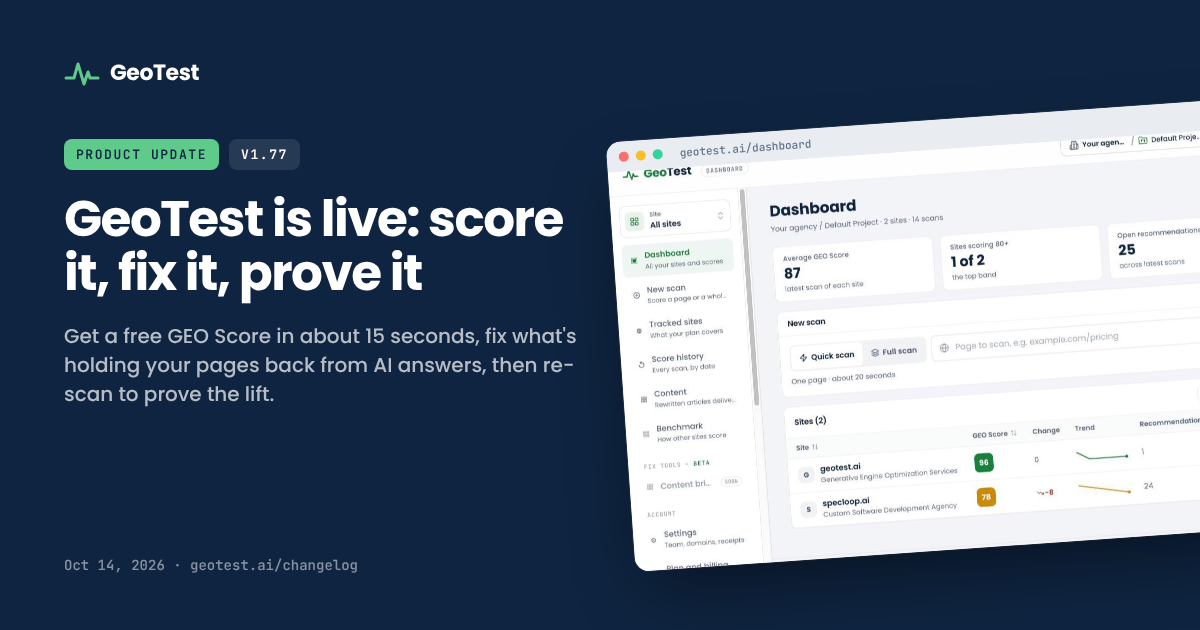
GeoTest is live. Paste a URL and in about 15 to 20 seconds you get a 0 to 100 GEO Score, the issues by name and where to start. Then fix it, re-scan and prove the score went up. More than 7,500 scans have already run on GeoTest since February 2026.
Key facts (13 October 2026):
- 7,512 scans run on GeoTest across about 6,000 distinct URLs since February 2026, 5,261 of them in the last 7 days.
- GEO Scoring Engine v6, live since 4 October 2026, with the full rubric published.
- Free Quick Scan: about 15 to 20 seconds, no signup to scan.
- Full scans crawl up to 200 pages per site.
- The GeoTest Benchmark: 4,999 business homepages, average GEO Score 47.5, not one A.
What is GeoTest?
GeoTest is a GEO scoring and fixing platform. It scores how ready your website's pages are for AI answer engines (ChatGPT, Perplexity, Google AI Overviews, Claude and Gemini) to read, trust and cite, then hands you the exact fixes.
GEO, or Generative Engine Optimization, is structuring a website so AI answer engines can read, trust and cite it. It complements SEO. It doesn't replace it. Here's the longer version of what GEO is.
The tagline is the product: Score it. Fix it. Prove it.
Why launch GeoTest now?
GeoTest is launching now because search behavior moved faster than websites did.
- Pew Research Center (July 2025): across 68,000 queries, searchers clicked a result 8% of the time when an AI summary appeared, versus 15% without. A 47% drop.
- Similarweb (2025): zero-click searches rose from 56% to 69% between May 2024 and May 2025. With AI Overviews showing, 83% of searches end without a click. In AI Mode, 93%.
- Chartbeat (early 2026): Google referral traffic to 2,500+ publishers fell 33% globally and 38% in the US.
- G2, The Answer Economy (March 2026): 71% of B2B software buyers rely on AI chatbots for software research.
Every one of those numbers points the same way. The answer is becoming the destination. If your page can't be quoted, you're relying on a click that happens less every month.
How is GeoTest different from AI visibility monitoring tools?
AI visibility monitors like Profound, Peec AI and OtterlyAI tell you whether you were mentioned. GeoTest ships the fixes.
Monitoring is a dashboard. This is a queue.
Semrush and Ahrefs do keyword rankings and backlinks. Lighthouse does Core Web Vitals. GeoTest does AI citation readiness: scoring, live AI citation tests, schema generation and per-page rewrites. Most teams should use more than one. I wrote up when to use each.
What do you get free with GeoTest?
The free Quick Scan gives you a 0 to 100 GEO Score for any page in about 15 to 20 seconds, with no signup to scan.
- Your GEO Score, from 0 to 100.
- Six category scores: Citation Worthiness, Answer Structure, Authority and Trust, Structured Data, Extractability and Freshness.
- The issues, by name.
- A start-here fix list.
Your email unlocks the full results. Start at the free GEO score checker or right on the homepage.
What do GeoTest paid plans add?
Paid plans take you from one page to the whole site, and from a score to the fixes.
- Full scan. Crawls up to 200 pages, scores every page, then adds a site layer. Site score = 70% page average + 30% site layer.
- Live citation test. Asks real AI engines, including ChatGPT and Perplexity, questions about your business and shows whether you get cited.
- Fixes written for your site. Ready-to-paste JSON-LD schema, FAQ copy, and copy-paste fix prompts and instructions for Lovable, Bolt, Wix and Shopify.
- AI article rewriter. A monthly allowance on every paid plan, with credit packs after that.
- The new dashboard. Every site, every score, every fix in one place.
Current plans are on the pricing page.
How does the test, fix, retest workflow work?
You test a page, fix what the report names, publish, then re-scan and watch the score move.
- Test. Run a scan. Get the score, the six categories and the issues.
- Fix. Work the fix list from the top. Paste the schema, add the FAQ, run the Lovable or Bolt prompt, rewrite the opener.
- Publish. Push the changes live.
- Retest. Re-scan and see the new score next to the old one.
One rule I won't bend: ticking a fix as done doesn't change your score. Only publishing and re-scanning does. A score you can game with checkboxes is worthless to you and to your clients.
What's in the new GeoTest dashboard?
The new dashboard, shipped in release 1.76 on 12 October 2026, is built around one question: how much score is still on the table?
- Every site in one table. Scores side by side.
- One page per site with its score history over time.
- A fix checklist showing "% fixes done" and "score left to gain".
Every release is dated on the changelog. We ship roughly weekly.
What does the GeoTest AI article rewriter do?
The AI article rewriter rewrites an existing article to GeoTest's standard: answer-first structure, facts, attributed sources, outbound citations, an FAQ and schema. You get a before score and a projected score before you publish.
The same approach took a GI Bill program page from 27 to 88 out of 100, through a teardown, an answer-first rewrite and JSON-LD schema. I broke down why answer-first works in a separate post.
Note: the GI Bill page was scored before GEO Scoring Engine v6 went live on 4 October 2026.
What does GeoTest done-for-you include?
On the top company plan, the GeoTest team does the work for you. Find out why ChatGPT isn't recommending you. Then we fix it.
- We fix the site issues your reports find, every month.
- We rewrite 4 of your existing articles a month, each with a before and projected score.
- Every change is confirmed by a re-scan after publishing.
More on the done-for-you page.
What does GeoTest offer agencies?
GeoTest gives agencies a way to score the prospect, sell the fix and prove the lift.
- Branded PDF reports.
- A shareable client report link.
- A sites table across all your clients.
- Team seats.
- A 30% recurring affiliate and referral program.
I ran a digital marketing agency for more than 10 years. This is the tool I wanted back then: a number a client understands, a list of work to sell, and a re-scan that proves you did it. Details on the partners page.
Why does GeoTest publish its scoring rubric?
GeoTest publishes its rubric because a score you can't check is a score you shouldn't trust. It's a published rubric, not a black box.
GEO Scoring Engine v6 has six categories: Citation Worthiness (34 points), Answer Structure (22), Authority and Trust (17), Structured Data (12), Extractability (8) and Freshness (7). The grades are A Excellent (90+), B Good (80 to 89), C Fair (65 to 79), D Moderate (50 to 64), E Poor (35 to 49) and F Critical (under 35). All of it is on the methodology page.
We also ran the rubric on 4,999 business homepages. The average was 47.5, and not one site scored an A. The best reached 80. The full results are on the benchmark page and in the benchmark write-up.
What's coming next for GeoTest?
GeoTest is bringing scoring and fixes into the tools people already build with.
- A Wix App Market app, with a free plan.
- A GeoTest MCP server and connector for Lovable, ChatGPT apps, Claude, Base44, Replit and Cursor.
- A WordPress plugin with one-click fixes.
- Then Shopify.
No dates here. When something ships, it lands on the changelog first.
How do you get started with GeoTest?
Paste your homepage URL into the Quick Scan on geotest.ai. That's it.
Start with the first item on your fix list, publish it and re-scan. Then do the next one.
And no, GeoTest can't promise ChatGPT will cite you. Nobody honest can. What it does is measure how ready you are, show you exactly what's in the way, and prove when you've fixed it.
Score it. Fix it. Prove it.
Your first GEO Score takes about 15 to 20 seconds, with no signup to scan.
Run a free Quick Scan →Free GEO resources: The GeoTest Benchmark Report 2026 and the AI Search Readiness Checklist
Frequently asked questions
What is GeoTest?
GeoTest is a GEO scoring and fixing platform at geotest.ai. It scores how ready a website's pages are for AI answer engines like ChatGPT, Perplexity and Google AI Overviews to read, trust and cite, then gives you the exact fixes.
Is GeoTest free?
Yes, the Quick Scan is free. Paste a URL and in about 15 to 20 seconds you get a 0 to 100 GEO Score, six category scores, the issues by name and a start-here fix list, with no signup to scan. Paid plans add full-site scans, live citation tests, written fixes and the AI rewriter.
Can GeoTest guarantee my site gets cited by ChatGPT?
No. No tool can guarantee citation by ChatGPT, Perplexity or any AI engine. GeoTest measures how ready your pages are, names the fixes and proves the score changed after you publish them.
How is GeoTest different from Semrush or Ahrefs?
Semrush and Ahrefs focus on keyword rankings and backlinks. GeoTest scores AI citation readiness page by page, runs live AI citation tests, generates schema and rewrites pages. Many teams use both.
Which AI engines does GeoTest cover?
GeoTest scores readiness for AI answer engines including ChatGPT, Perplexity, Google AI Overviews, Claude and Gemini. Its live citation test asks real AI engines, including ChatGPT and Perplexity, questions about your business and shows whether you get cited.