Blog › Case study
How we took geotest.ai from 83 to 93 in a day
By Jason Gordon · October 25, 2026
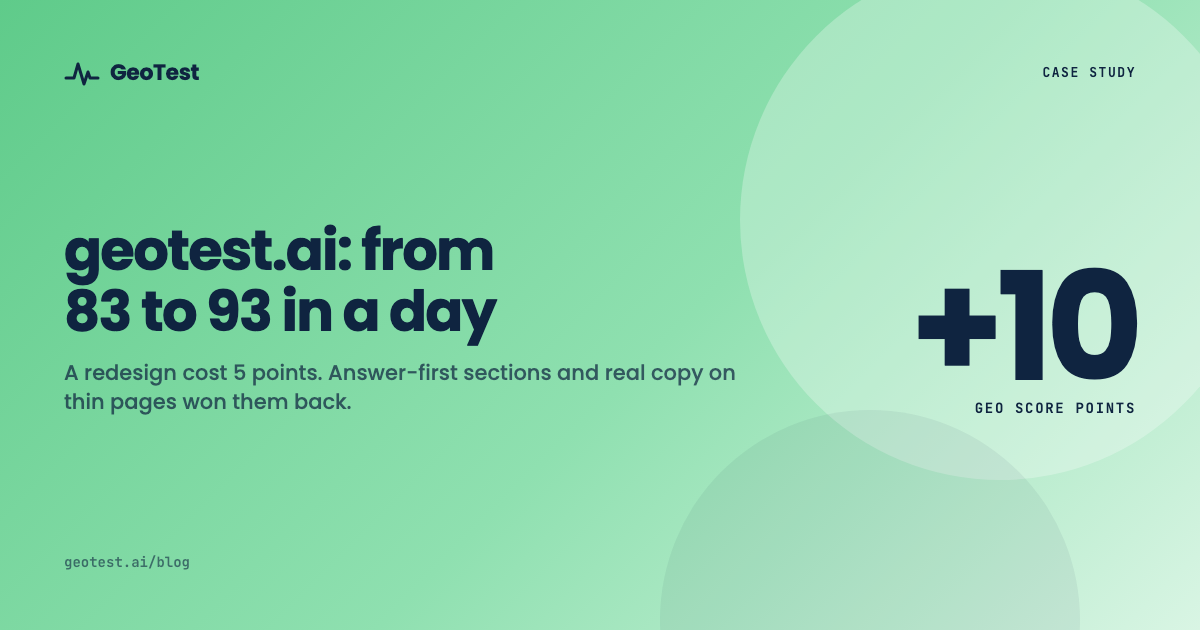
A redesign took geotest.ai from a GEO Score of 88 to 83 overnight. The next day we fixed what the scan named and a fresh full scan of all 37 pages came back at 93, grade A. This is what broke, what we changed, and the numbers before and after, from GeoTest's own scans of its own site.
We rebuilt the GeoTest homepage on 24 October 2026 and carried the same story through the pricing, product and explainer pages over the next two releases. The pages looked better. The daily scan, which had read 88 for three days running, came back at 83. Nothing was broken in the browser, so without the scan we would not have known.
What did the redesign cost geotest.ai?
The redesign cost geotest.ai 5 points: the site score fell from 88 to 83, and the average page score fell from 86.3 to 79.9 across 37 pages. The site layer, the 30% of the score that only a full crawl can measure, barely moved (92 to 90). Almost all of the loss was on the pages themselves, in two categories: Citation Worthiness fell from 26 to 20 out of 34 points, and Answer Structure from 18 to 16 out of 22.
Why did the score drop from 88 to 83?
Three things caused the drop, and the full scan named each one with the pages it affected:
- Sections did not open with the answer. The new pages used short, punchy headings ("Made for AI answers, not rankings", "Simple monthly pricing") followed by a sentence that did not address the heading, or by no text at all. The check failed on 29 of 37 pages, up from 20 the day before.
- Three pages were too thin to count. Book a demo had 86 words of main content, Where to find us 77 and Feature requests 42. Under 150 words a page is capped at 40, so three pages scored 40 each, and the author page (about 250 words) was capped at 70.
- The blog index lost its footing. The scan crawled the blog index and its four category filters as five pages, and they scored 74 to 78: post cards used headings with excerpts that did not repeat the title's subject, and the schema type did not match a list of articles.
None of this showed in a browser. A heading with a slogan under it reads fine to a person. An answer engine lifting a passage out of the page gets a slogan with nothing to quote.
How did we fix sections that did not open with the answer?
We fixed sections that did not open with the answer by rewriting the first sentence under every failing heading so it answers that heading in 8 words or more, using a word from the heading. The GEO Score check passes a page when 80% of its H2 and H3 sections do this. Three patterns covered most of the work:
- Lead lines. A heading followed straight by cards, a table or questions now has one sentence under it. "Frequently asked questions" is followed by "The questions below about GeoTest pricing and plans are the ones people ask most, each answered in a few sentences."
- Answers that restate the question. FAQ answers that opened "Yes." or "No." now open "Yes, you can cancel a paid GeoTest plan at any time." The first sentence carries the subject, so it still makes sense when an engine quotes it alone.
- Calls to action are not sections. The scan boxes and closing cards had their titles marked up as headings. They are prompts to act, not sections of the page, so their titles are now styled text and no longer count as sections with nothing under them.
Answer Structure went from 16 to 22 out of 22. We wrote about why this category costs the most points across the web in Answer Structure is where 4,999 websites lose the most GEO points; this time it was our own site.
How did we fix the pages capped at 40?
We fixed the pages capped at 40 by giving each one real content, not filler: Book a demo, Where to find us, Feature requests, the author page and the free resources page now carry 700 to 1,000 words each. Book a demo explains what the demo covers and what a written fix looks like. Feature requests explains how the board works and what each status means. The resources page summarises what the benchmark report found. Each page also got eight questions with full answers, and every figure on them comes from our plans or our published benchmark report. We added no reviews, logos or customer counts we do not have.
What else changed in the scan?
Three smaller fixes also showed up in the scan:
- The blog index is a list again. Post titles on the blog are list items, not headings, and the page declares itself a CollectionPage listing exactly the posts shown, so its schema matches what a reader sees.
- Questions in the schema are on the page. Posts written in our editor declared FAQ questions in their structured data that were not visible on the page. They are now shown, so the markup and the page agree.
- A broken page for crawlers. One post's structured data contained example code with a closing script tag, which cut the page short for any crawler that saved and re-read it. The tag is now removed from the schema text.
What did the full scan show after the fixes?
The full scan after the fixes showed a site score of 93, grade A, with the average page at 94.3 and the site layer at 90, across 37 pages. The scan ran on 25 October 2026 at 02:52 UTC. Every category but one is now at full marks:
| Category | Before (83) | After (93) |
|---|---|---|
| Citation Worthiness | 20 / 34 | 25 / 34 |
| Answer Structure | 16 / 22 | 22 / 22 |
| Authority and Trust | 15 / 17 | 17 / 17 |
| Structured Data | 11 / 12 | 12 / 12 |
| Freshness | 7 / 7 | 7 / 7 |
| Extractability | 7 / 8 | 8 / 8 |
| Pages average | 79.9 | 94.3 |
| Site score | 83 | 93 |
You can open the report itself: GeoTest's own report on geotest.ai lists all 14 fixes that are still open, each with what it is worth in points.
What is still left to fix on geotest.ai?
Citation Worthiness is still left to fix on geotest.ai, at 25 of 34 points, along with two site-layer checks: topic clusters at 4 of 12 and site-wide fact density at 5 of 7. Citation Worthiness rewards specific facts with their source beside them, quotations from named people and coverage of the facts that cited pages on a topic agree on. Topic clusters reward three or more pages on one subject that link to each other from the body copy. Both take writing, not markup, so they are the next round.
What should you take from this for your own site?
Take one habit from this for your own site: scan after every redesign, not just before it. A redesign changes headings, moves copy into cards and shortens pages, and each of those can cost points without anything looking wrong. Run a free Quick Scan of the pages you changed, check which sections no longer open with an answer, and look for pages that dropped under 150 or 300 words. The free scan names every issue and prices it in points; paid plans write the fix from your own pages.
Free GEO resources: The GeoTest Benchmark Report 2026 and the AI Search Readiness Checklist
Frequently asked questions
Short answers to common questions about the topics in this post.
Why did the geotest.ai GEO Score drop after the redesign?
The geotest.ai GEO Score dropped from 88 to 83 because the new pages had headings followed by text that did not answer them, three pages fell under 150 words and were capped at 40, and the blog index lost its matching schema. None of it was visible in a browser; the full scan named each issue and the pages it affected.
How long did it take to get from 83 to 93?
The fixes took about a day to take geotest.ai from 83 to 93: the drop showed in the scans on the evening of 24 October 2026, and the full scan after the fixes ran at 02:52 UTC on 25 October, scoring 93 across 37 pages.
What does a section that opens with the answer look like?
A section that opens with the answer starts with a sentence of 8 words or more that answers its heading and uses a word from it. Under the heading "Can I cancel a paid GeoTest plan?" the first sentence is "Yes, you can cancel a paid GeoTest plan at any time", not just "Yes."
Why are pages under 150 words capped at 40?
Pages under 150 words of main content are capped at 40 because an answer engine has too little on them to quote or trust; pages under 300 words are capped at 70. The fix is real content that answers what a visitor to that page needs, not filler.
Can I see GeoTest's own report?
Yes, GeoTest's own report on geotest.ai is public at geotest.ai/r/geotest-ai. It shows the 93 score, the six categories and all 14 open fixes with what each is worth in points; writing the fix is on paid plans.
How do I check my own site after a redesign?
Check your own site after a redesign with a free Quick Scan of each page you changed at geotest.ai/free-geo-score-checker. It gives the GEO Score and every issue priced in points in about 15 seconds; paid plans write the fix from your own pages.